You know what you want to build. Writing it down — PRD, architecture, metrics — is what eats the week.
Describe what you want to build get docs that actually agree with each other.
A staged pipeline turns one conversation into a PRD, architecture doc, and success metrics that cross-reference each other — not three disconnected documents.
Free to try · no account required
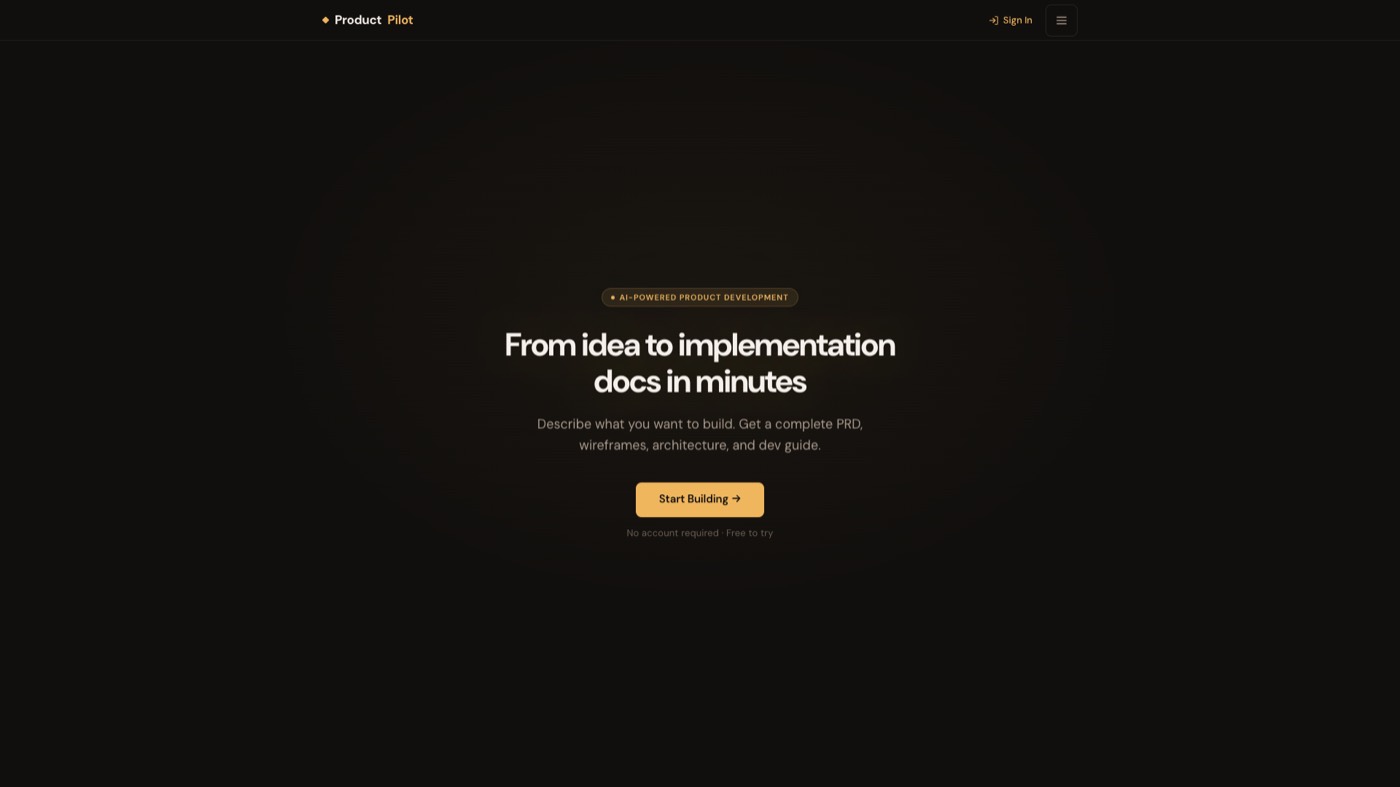
Describe what you want to build, get a full spec
The landing page gets straight to it — describe the idea in a text box and it starts generating. No account required to try it; sign in only if you want to save the project.
Requirements come first, one goal at a time
The Requirements Definition stage tracks a discussion checklist — target users, core use cases, MVP scope, success metrics — while the spec text builds alongside it in real time.
Every section checks itself against the others
Generation runs in stages — requirements, then user stories with acceptance criteria, then architecture informed by those stories, then metrics derived from the acceptance criteria. Each stage validates against the ones before it, catching contradictions before they reach you.
Change one thing, and it propagates
Ask for changes in plain language — "make the auth section more detailed," "add an offline mode" — and the update flows through the architecture, metrics, and risk sections that depend on it, not just the paragraph you pointed at.
- No account required to try it — sign in only if you want to save your work
- Bring-your-own-key API keys are encrypted at rest (AES-256-GCM), never stored in plaintext
- Auth email links are never logged in production — delivery fails closed instead of leaking a token
Do I need an account?
No — you can start building immediately. Sign in with email/password, a magic link, or Google only if you want to save and return to a project.
What AI models does it use?
A free Groq (Llama 3.3 70B) demo tier by default, with Anthropic Claude and OpenAI available bring-your-own-key.
What does it actually generate?
A PRD with user stories and acceptance criteria, a technical architecture doc, success metrics tied to those stories, and a risk assessment — generated in stages so each one references the others.
Is this a finished product or still changing?
It's a live, working app — deployed and public — that I use for my own projects and keep iterating on.
Every PRD I’d written started strong and drifted — the user stories stopped matching the architecture by section three, and the success metrics were an afterthought bolted on at the end. Writing that coherence by hand takes hours I usually didn’t have, so I’d ship a thinner spec than I wanted and pay for it later in implementation.
Product Pilot is the fix: describe what you want to build in plain language, and it generates the PRD, architecture, and metrics in stages, each one validated against what came before. Ask it to change something and the edit propagates through the sections that depend on it, instead of leaving them to quietly drift apart again.
Free to try · no account required