Every AI headline shows up alone, with no thread back to what came before it.
Turn scattered AI coverage into a connected, cited knowledge graph.
Multi-model summaries route between Groq and OpenAI, extract entities, and filter them before linking accepted entities into a scored knowledge graph.
Live web app · new coverage ingested automatically

- 76%
- cheaper inference via Groq LPU routing vs. OpenAI-only
- 9,556
- entities scored in the first full-corpus run
- 55ms
- response time from the built spaCy verifier, not yet wired into live extraction
Product walkthroughs
See it at work
Ranked by how many sources are covering it
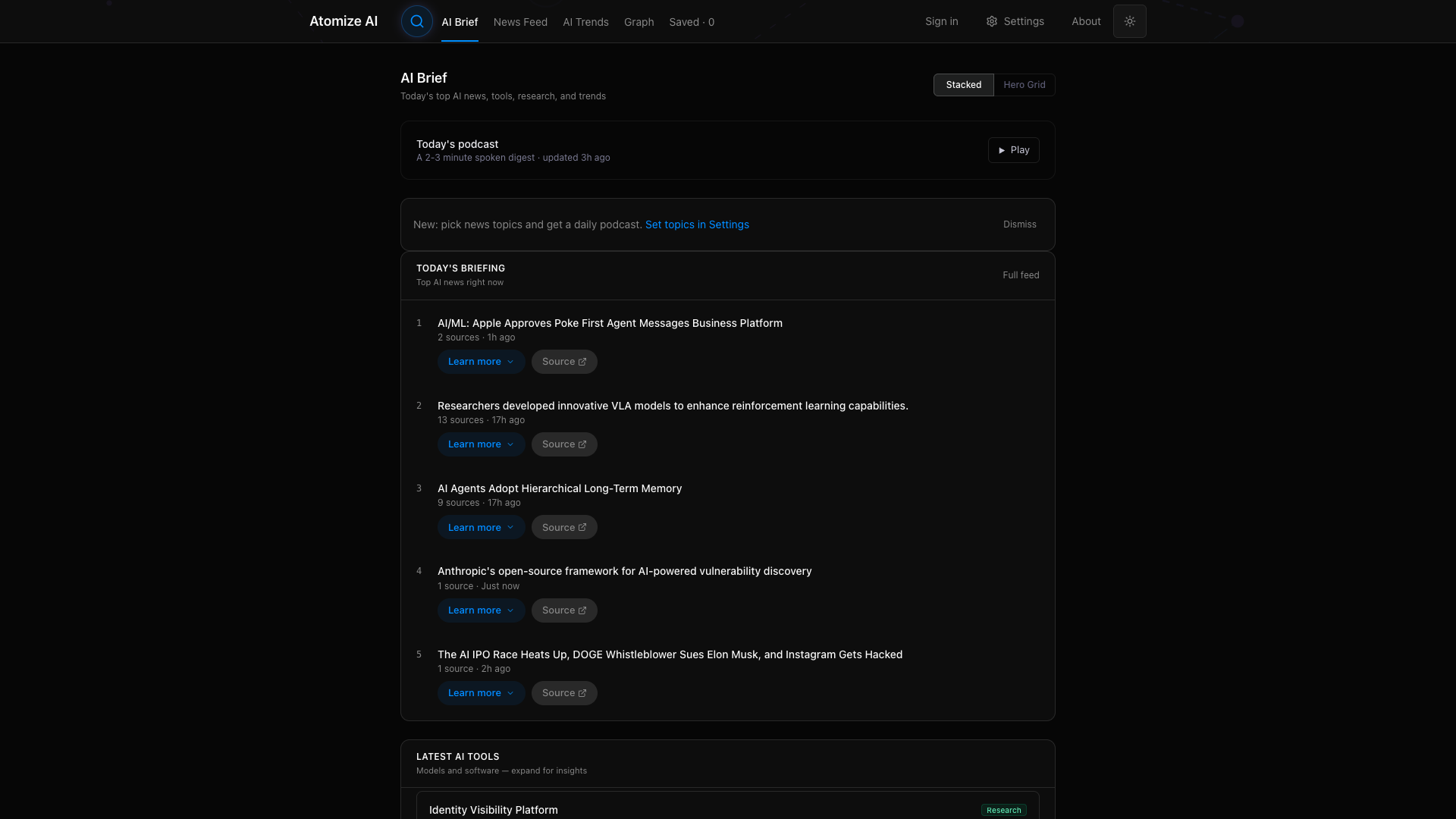
AI Brief opens on a podcast-style digest and a ranked Today's Briefing — each item shows how many sources are covering it, so you can see what's converging before you read the piece.
Ask a question, get a cited synthesis
AI Search pulls from indexed articles on a topic. Synthesis-capable runs return a structured answer with numbered citations; browse and fallback modes return source results instead. A worked "Enterprise AI Adoption" run used 50 articles, but live result counts and modes vary as the corpus changes.
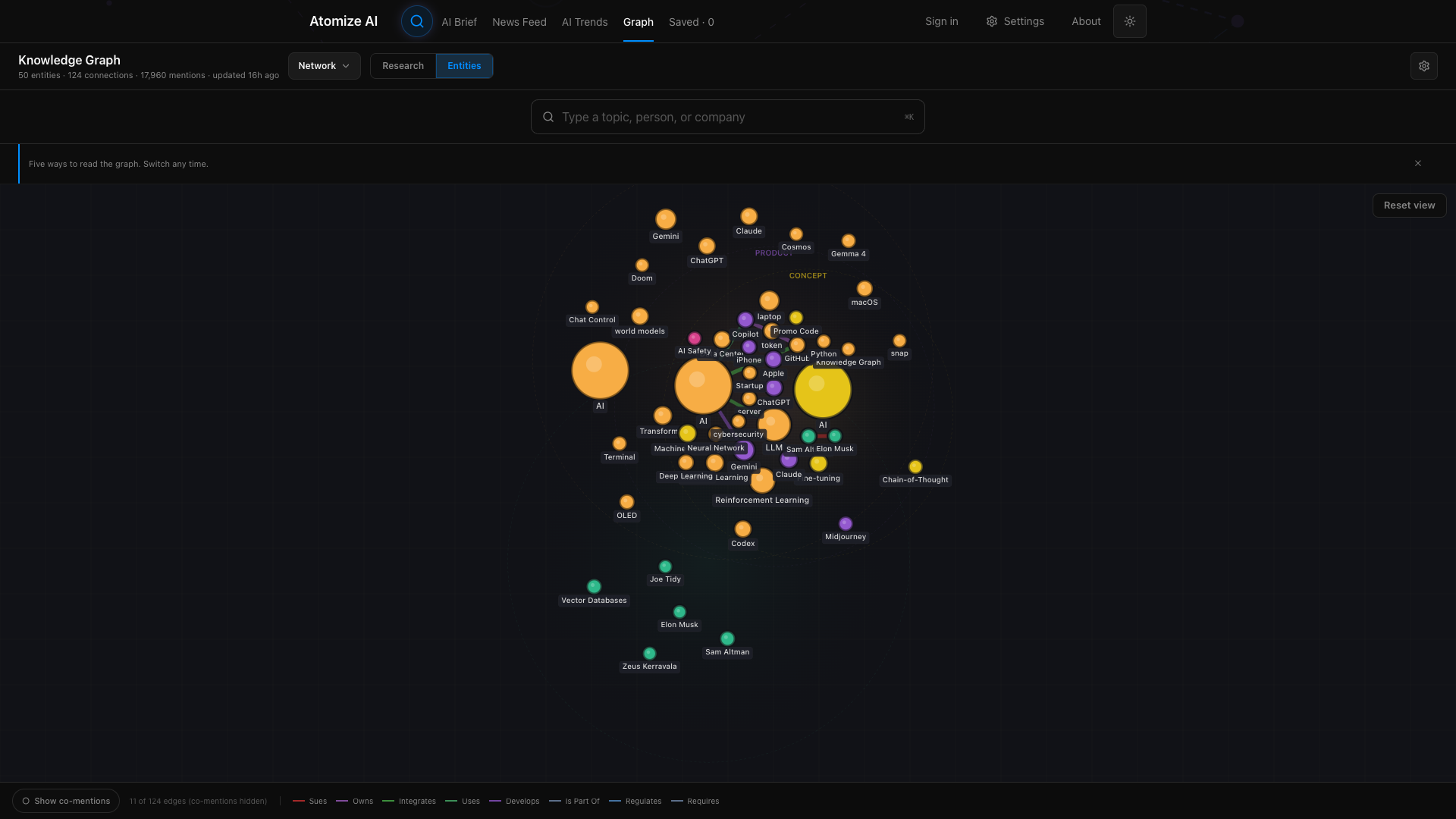
Entities and relationships, not just tags
Every article can feed a graph of typed relationships — owns, integrates, develops, regulates — extracted by models and filtered before admission. A separate spaCy grammatical verifier was built and deployed, but it is not wired into the live extraction path today. A six-signal scoring system keeps entity admission from drifting into noise; entities below threshold land in a review queue.
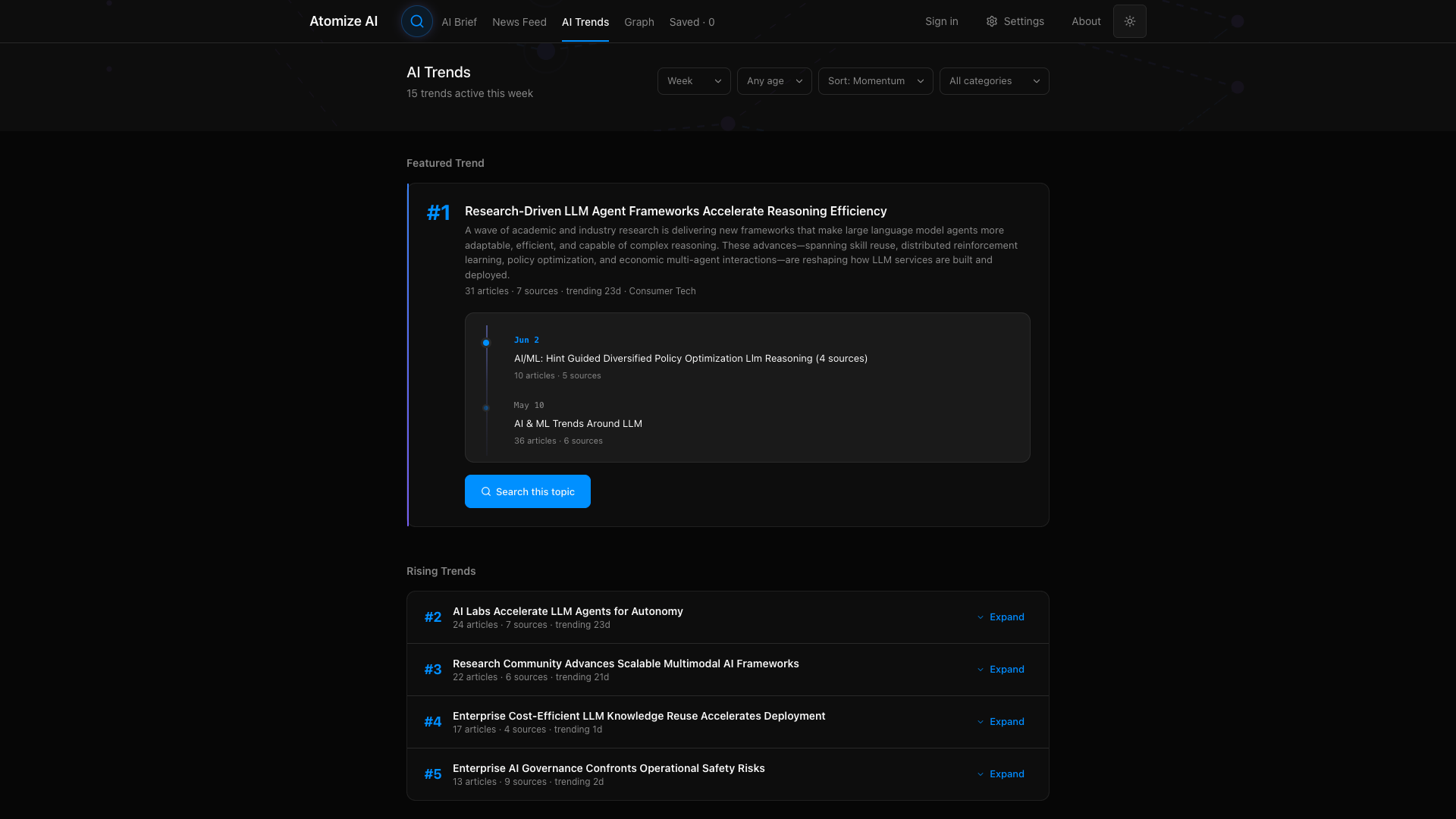
A rolling score of volume and source diversity
Trends are scored by article volume and source diversity over a rolling window, so a featured trend reflects real convergence rather than one loud outlet. Each trend links to a timeline and topic-specific search for the drill-down.
- The built spaCy verifier is disclosed as not yet wired into live extraction — no shipped claim where the integration is still pending
- No entity passes into the canonical graph without clearing the six-signal review threshold
- Every synthesized finding cites back to its source article — no unsourced claims
What does it actually pull from?
Academic and corporate AI research — arXiv, Anthropic, and OpenAI — alongside broader AI news coverage, indexed and cross-linked into the knowledge graph.
How does the graph avoid turning into a pile of every name that ever appeared?
A six-signal scoring system — word frequency, capitalization and part-of-speech pattern, entity type, multi-word count, title position, and mention frequency — gates every extracted entity. Anything below threshold lands in a review queue instead of the canonical graph.
Why route between Groq and OpenAI instead of picking one?
A 10-model router sends straightforward summarization and entity extraction to Groq's LPUs — about 76% cheaper — and reserves OpenAI for queries that need deeper reasoning.
Is the code open source?
Not currently — the repo is private. The app itself is live and free to use at atomize-ai.vercel.app.
Atomize AI started as Atomize News, an RSS aggregator, but general tech headlines don’t connect to each other the way research does. I wanted to track AI developments across arXiv, Anthropic, and OpenAI and actually see how they relate — not just read them in sequence.
The hard part turned out to be entity accuracy. LLMs alone will happily reverse a relationship — “Google acquired DeepMind” becomes “DeepMind acquired Google” — so I built and deployed a spaCy microservice to check grammatical structure. It is not wired into the live extraction path yet, which means current graph relationships do not receive that second check. A six-signal scoring pass does run during ingestion to keep entity admission from turning the graph into a pile of every name and concept that appeared in an article. Multi-model routing across Groq and OpenAI keeps the pipeline affordable enough to run continuously.
Live web app · new coverage ingested automatically